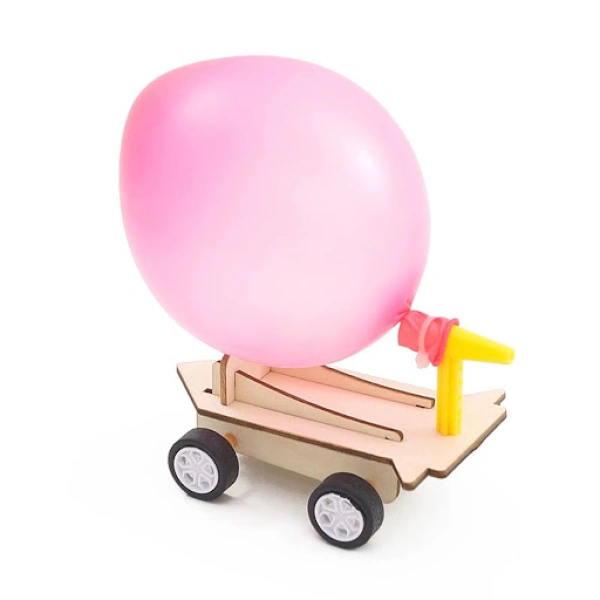
Exploring Newton's First Law through experiments
Exploring Newton's First Law through experiments
Exploring Newton's First Law through experiments
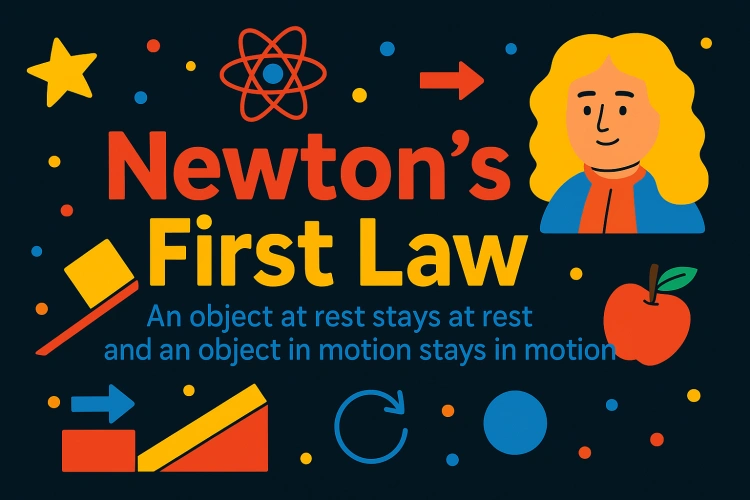
Exploring Newton's First Law Through Experiments
Newton's First Law of Motion is a fundamental concept in physics that explains how objects behave when no external forces act upon them. Often referred to as the law of inertia, it states that an object at rest will remain at rest, and an object in motion will continue moving at a constant velocity unless acted upon by an unbalanced force. In this article, we'll delve into the principles of Newtonian physics and explore engaging experiments that can be performed at home or in a class setting to illustrate Newton's First Law.
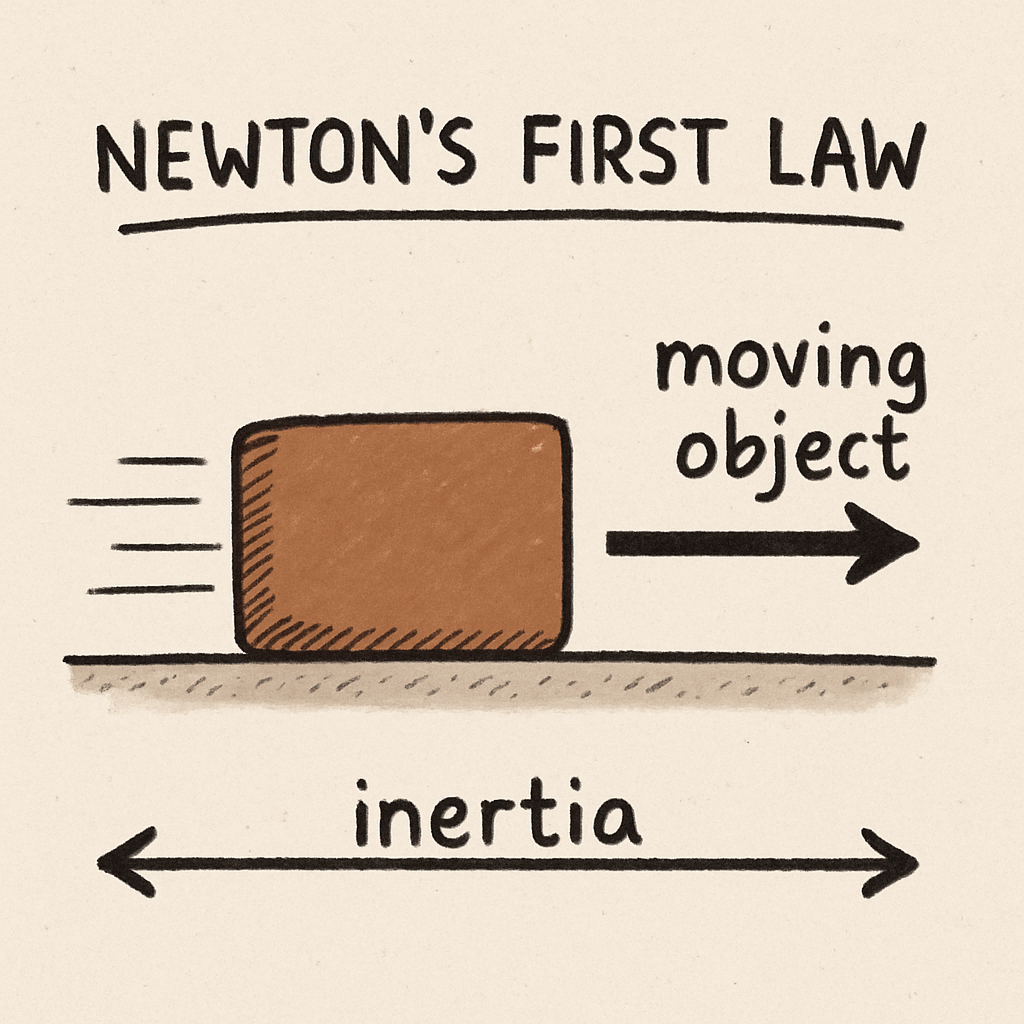
To understand Newton's First Law, it's important to grasp the concept of inertia. Inertia is the tendency of an object to resist changes in its state of motion. This means that an object will not change its speed or direction unless a force is applied to it. For example, a book lying on a table will stay there until someone moves it, and a ball rolling on the ground will keep rolling until friction or another force stops it.
The Role of Forces
Forces are pushes or pulls that can change the motion of an object. In the absence of unbalanced forces, an object will maintain its current state. This balance is essential in understanding why objects move or stay still. When forces are balanced, their effects cancel each other out, and no change in motion occurs. Unbalanced forces, on the other hand, lead to changes in speed or direction.
Simple Experiments to Demonstrate Newton's First Law
Now that we've covered the basics of Newton's First Law, let's dive into some experiments that vividly demonstrate these principles. These activities can be easily conducted at home or in a classroom with minimal equipment.
Experiment : The Coin and Card Trick
Materials Needed:
- A coin
- An index card
- A glass or cup
Procedure:
- Place the index card flat on the rim of the glass.
- Position the coin in the center of the card.
- Quickly flick the edge of the card with your finger.
Observation: The card will fly away, but the coin will drop straight down into the glass. This experiment illustrates that the coin remains at rest due to inertia until gravity (an unbalanced force) acts on it when the card is removed.
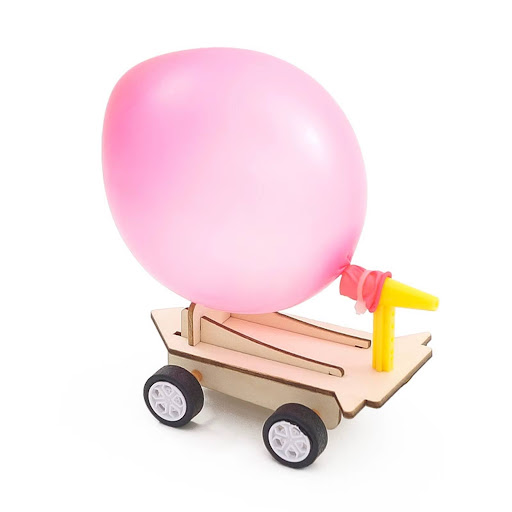
Experiment: With Ready-Made Newton Car Kit
Materials Needed:
Procedure:
- Assemble the Car: Follow the instructions provided in the kit to build your Newton car, ensuring all components are securely fitted for optimal performance.
- Set Up the Experiment: Position the car on a flat surface, making sure it's ready for the balloon to be inflated.
- Conduct the Experiment:Inflate the balloon attached to the car without tying it off.Release the balloon and observe the car's movement as the air escapes.Notice how the car propels forward due to the thrust created by the deflating balloon.
How It Relates to Newton's First Law:
- Inertia of Rest: When the balloon car is stationary before the balloon is released, it exemplifies the "object at rest stays at rest" part of Newton's First Law. The car will remain at rest until an external, unbalanced force (the thrust from the escaping air) acts upon it.
- Inertia of Motion: Once the balloon car is propelled forward by the escaping air, it illustrates the "object in motion stays in motion with constant velocity" aspect of the law. In the absence of external forces like friction or air resistance, the car would theoretically continue moving indefinitely in a straight line at a constant speed.
- Effect of Unbalanced Forces: As the balloon car moves, it will eventually slow down and stop due to external forces of friction (between the wheels and the surface) and air resistance acting against it. This highlights that an object's state of motion changes when acted upon by unbalanced forces, a fundamental concept of Newton's First Law.
Observation:
By observing the car's initial state of rest, its movement upon release, and its eventual stopping, students can grasp the concepts of inertia and the impact of unbalanced forces on an object's motion. This hands-on experience reinforces their understanding of Newton's First Law in a tangible and engaging way.
Would you like to add anything else or need further modifications?
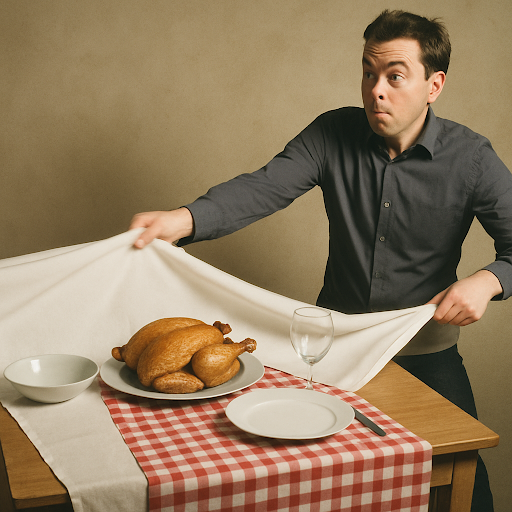
Experiment : The Tablecloth Trick
Materials Needed:
- A smooth tablecloth
- Several plastic cups or lightweight tableware
Procedure:
- Place the cups on the tablecloth, ensuring they are spaced apart.
- Firmly grip the edge of the tablecloth.
- Quickly pull the cloth straight out from under the cups.
Observation: The cups should remain largely undisturbed. The inertia of the cups keeps them in place while the cloth is removed quickly enough to minimize the effects of friction.
Experiment : Rolling Ball on a Track
Materials Needed:
- A smooth board or a long piece of cardboard
- A small ball (e.g., a marble or a toy car)
Procedure:
- Set the board at a slight incline.
- Place the ball at the top and release it.
- Observe its motion as it rolls down and continues on a flat surface.
Observation: Once the ball is on the flat surface, it continues to roll at a constant speed until friction or another force slows it down, demonstrating Newton's First Law.
Applications of Newton's First Law
Understanding Newton's First Law is not only educational but also practical. It helps us grasp the principles behind seatbelt design, sports strategies, and even space travel. Let's explore a few real-world applications:
Automobile Safety
Seatbelts in vehicles are a direct application of Newton's First Law. In a sudden stop or collision, a seatbelt provides the necessary unbalanced force to change the motion of passengers, keeping them securely in place and preventing injury.
Sports
Athletes use the principles of inertia to their advantage. For instance, a soccer player learns to strike the ball with the right amount of force to overcome its inertia and send it toward the goal. Understanding how to manipulate forces allows athletes to excel in their respective sports.
Space Exploration
In the vacuum of space, where friction is negligible, spacecraft can travel vast distances using minimal fuel. This is because, once set in motion, they continue at a constant speed without the need for additional propulsion, thanks to inertia.
Conclusion
Newton's First Law of Motion is a cornerstone of physics, providing insight into the behavior of objects at rest and in motion. By conducting simple experiments, we can observe these principles firsthand and gain a deeper understanding of the forces that govern our world. Whether you're at home or in a classroom, these experiments offer an engaging way to explore the wonders of Newtonian physics. As you conduct these activities, remember that the key to mastering physics lies in curiosity and exploration.