Exploring Volcanoes: Fun Activities & Experiments for Young Learners
Exploring Volcanoes: Activities for Young Learners
Exploring Volcanoes: Activities for Young Learners
Exploring Volcanoes: Activities for Young Learners
Volcanoes have long fascinated people of all ages, with their explosive eruptions and flowing lava captivating the imagination. For young learners, exploring the world of volcanoes can be both an exciting and educational journey. Through various activities, children can learn about the science behind these natural wonders, their impact on the environment, and the fascinating facts that make them unique. This article will guide you through engaging volcano activities, useful facts, and ready-made kits that can be used at home or in the classroom.
Before diving into hands-on activities, it’s essential for young learners to grasp the basic concepts of volcanoes. Volcanoes are openings in the Earth's surface where molten rock, ash, and gases erupt. They are formed by the movement of tectonic plates and can be found both on land and underwater.
Key Volcano Facts for Kids
To spark interest and provide a foundation for learning, share these fascinating volcano facts with your young learners:
- What is a Volcano? A volcano is a mountain that opens downward to a pool of molten rock below the Earth's surface. When pressure builds up, eruptions occur.
- Types of Volcanoes: There are three main types of volcanoes: shield volcanoes, stratovolcanoes, and cinder cone volcanoes. Each type has its shape and eruption style.
- Famous Volcanoes: Some well-known volcanoes include Mount Vesuvius in Italy, Mount St. Helens in the USA, and Mount Fuji in Japan.
- Volcano Eruptions: Eruptions can vary in intensity and duration, from slow lava flows to violent explosions.
- Volcanic Rocks: Lava cools and hardens into volcanic rocks, like basalt and pumice.
Engaging Volcano Activities
Hands-on activities can make learning about volcanoes interactive and fun. Here are some activities that can be done in class or at home to explore the fascinating world of volcanoes.
Creating a Volcano Model
Building a model volcano is a classic activity that helps children understand how eruptions occur. Here's a simple way to create one:
Materials Needed:
- Plastic bottle or small cup
- Baking soda
- Vinegar
- Food coloring (optional)
- Modeling clay or papier-mâché
Instructions:
- Secure the plastic bottle or cup on a tray or dish to catch overflow.
- Use modeling clay or papier-mâché to shape the volcano around the bottle, leaving the top open.
- Add a few tablespoons of baking soda to the bottle.
- Mix food coloring with vinegar to simulate lava.
- Pour the vinegar mixture into the bottle and watch the "eruption"!
Volcanic Rock Collection
Collecting volcanic rocks can be an exciting way for kids to learn about different types of rocks formed by volcanic activity. If you're near a location with volcanic rock, take a field trip to gather samples. Otherwise, you can purchase a rock collection kit online.
Activity Steps:
- Identify and label different types of volcanic rocks.
- Use a magnifying glass to examine the rocks' textures and colors.
- Research how each rock type forms and its uses in everyday life.
Interactive Volcano Eruption Game
Design a game that simulates a volcanic eruption and the effects it can have on the environment. This activity encourages critical thinking and problem-solving.
Game Setup:
- Create a board game or use an online platform.
- Include challenges and scenarios involving volcanic eruptions.
- Players must make decisions to protect wildlife and communities.
- Discuss the outcomes and what strategies worked best.
Ready-Made Volcano Kits
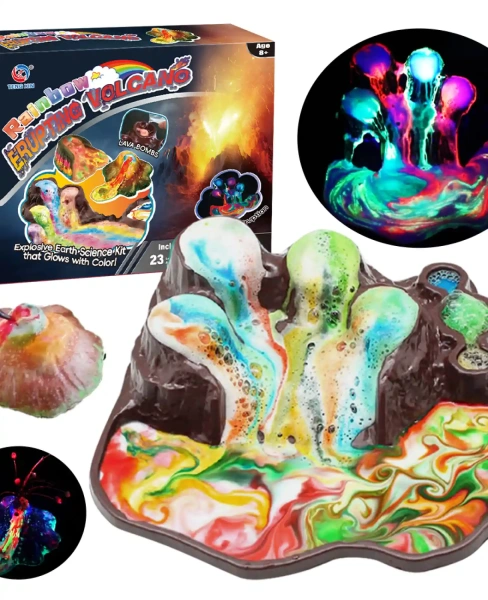
For an all-in-one experience, consider using ready-made volcano kits. These kits provide everything needed to conduct experiments and learn about volcanoes without the hassle of gathering supplies. A particularly engaging option is the Glow Volcano kit.
Glow Volcano: A Hands-On Kit for Learning
<<<< INSERT VIDEO CONTENT}{{{{{{
The Glow Volcano kit is designed to make learning about volcanoes both interactive and memorable. It includes materials to build and paint a reusable volcano model, along with special glow-in-the-dark paint to simulate a glowing lava flow.
This kit offers an opportunity for kids to:
- Construct and Paint: Use the included materials to build a realistic volcano model, allowing for a creative outlet.
- Create Glowing Eruptions: The kit's unique glow-in-the-dark feature makes the classic baking soda and vinegar reaction even more exciting by mimicking the fiery glow of real lava.
- Learn Through Experimentation: The kit comes with clear instructions, guiding children through the process of making their volcano erupt and helping them understand the basic science behind the chemical reaction.
Benefits of Ready-Made Kits
- Convenience: Kits come with all necessary materials and instructions, making them a perfect grab-and-go educational activity.
- Educational Value: Many kits, including the Glow Volcano, provide informative booklets or online resources that teach about geology, types of volcanoes, and the science of eruptions.
- Safety: Designed with safety in mind for young learners, these kits ensure a controlled and fun environment for scientific exploration.
Volcanoes in the Classroom
Integrating volcano activities into the classroom can enhance science education and promote curiosity among students. Here are a few ways to incorporate volcanoes into your curriculum:
Volcano Science Projects
Assign volcano-related projects that encourage research and presentation skills. Students can explore topics like historical eruptions, the role of volcanoes in Earth's geology, or how volcanic activity affects climate.
Collaborative Learning
Encourage teamwork by assigning group projects where students build models, conduct experiments, and present their findings. Collaborative learning fosters communication skills and allows students to learn from each other.
Virtual Volcano Tours
Take advantage of technology by exploring virtual volcano tours. Many educational websites and organizations offer virtual tours of famous volcanoes, providing an immersive learning experience without leaving the classroom.
Conclusion
Exploring volcanoes through interactive activities, ready-made kits, and educational resources makes learning fun and accessible for young learners. By understanding the science behind volcanoes and engaging in hands-on experiences, children can develop a deeper appreciation for these natural wonders and the role they play in shaping our planet. Whether at home or in the classroom, these volcano activities offer a gateway to discovery and a platform for lifelong learning.