
Hands-On Activities for Newton's Second Law
Hands-On Activities for Newton's Second Law
Hands-On Activities for Newton's Second Law
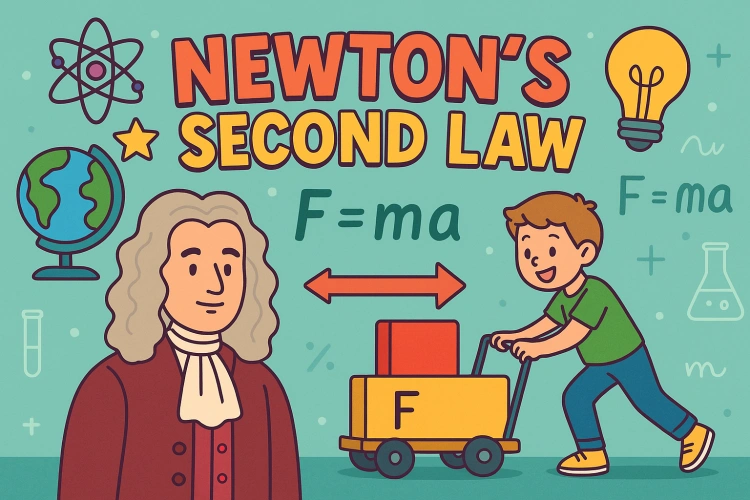
Newton’s Second Law of Motion states that the force on an object equals its mass multiplied by its acceleration. While it’s a core principle of physics, it becomes much easier to understand through engaging, hands-on activities. In this article, we’ll explore fun and interactive DIY experiments that bring Newton’s Second Law to life and make learning both exciting and memorable.
What is Newton's Second Law?
Newton's Second Law of Motion is a key principle in physics. It is often represented by the equation F=ma, where F stands for force, m stands for mass, and a stands for acceleration. This law explains how the velocity of an object changes when it is subjected to an external force.
In simpler terms, the more mass an object has, the more force is needed to accelerate it. Conversely, the greater the force applied to an object, the more it will accelerate. This fundamental principle is applicable in numerous real-world scenarios, from driving a car to launching a rocket.
DIY Experiment 1: The Classic Cart and Weights
One of the simplest ways to demonstrate Newton's Second Law is through the classic cart and weights experiment. This activity uses a small cart, some weights, and a smooth surface to illustrate the relationship between mass, force, and acceleration.
Materials Needed
- A small wheeled cart
- Weights (or objects of known mass)
- A smooth, flat surface
- A measuring tape
- A stopwatch
Procedure
- Set Up the Experiment: Place the cart on the flat surface. Attach a string to the cart, allowing it to hang over the edge of the table with weights attached.
- Conduct the Experiment: Gradually add weights to the string and release the cart. Use the stopwatch to measure the time it takes for the cart to travel a certain distance.
- Record the Results: Note the weight applied and the time taken for each trial. Calculate the acceleration using the formula a = 2d/t², where d is the distance traveled and t is the time taken.
- Analyze the Data: Compare how the acceleration changes with different weights. This will illustrate how increased force leads to increased acceleration, confirming Newton's Second Law.
DIY Experiment 2: Balloon Rocket
The balloon rocket experiment is a fun and exciting way to demonstrate Newton's Second Law. This activity uses the force of air escaping from a balloon to propel it along a string.
Materials Needed
- Balloons
- String
- Tape
- Straws
- Measuring tape
Procedure
- Set Up the Rocket: Thread a straw onto a long piece of string. Secure the string between two points, such as across a room. Inflate a balloon but do not tie it.
- Prepare for Launch: Tape the inflated balloon to the straw and hold the end of the balloon closed.
- Launch the Rocket: Release the balloon and observe as it travels along the string. Measure the distance traveled.
- Experiment with Variables: Try using different sizes of balloons or adding a small weight to the balloon to see how the mass affects the distance traveled.
Analysis
This experiment visually demonstrates how the force (air leaving the balloon) and the mass (balloon and added weights) affect the acceleration and distance traveled, bringing Newton's Second Law to life.
Conclusion
Hands-on activities are an invaluable tool for understanding complex scientific principles like Newton's Second Law. By engaging in these experiments, learners of all ages can see the direct relationship between force, mass, and acceleration. Whether it's through a simple cart and weights setup, a balloon rocket, or a homemade catapult, these DIY experiments make physics both accessible and exciting.
With these activities, students can move beyond theoretical understanding and experience the dynamic principles of physics in action.